How Far Can We Practically See? | G1
At first glance, the question seems simple. If you stand in an open field and look toward the horizon, your vision appears to fade gradually into the distance. However, the true limit of what we can see has little to do with the strength of our eyes. Instead, it depends on a much deeper principle i.e. light must travel from an object to us before we can see it. Once we follow this idea carefully, the question expands far beyond Earth. It leads us through cosmic distances, ancient radiation, and ultimately to a boundary in the universe known as the Surface of Last Scattering.
We See the Universe Through Light
Every object we see becomes visible because it emits or reflects light. That light travels through space and eventually reaches our eyes. Only then does the image form in our minds. Because light moves at a finite speed of about 300,000 kilometers per second, it always takes a small amount of time to travel from one place to another. Even in everyday life, this delay exists, although it is usually too small to notice. For instance:-
- Light from the Moon takes about one second to reach Earth.
- Light from the Sun takes about eight minutes to reach Earth.
In both cases, we never see these objects exactly as they are in the present. Instead, we see them as they appeared when their light began its journey toward us. Therefore, vision is not simply about distance, it is also about time.
Measuring Distance with Light-Years
When we begin observing objects beyond our solar system, the distances become so vast that ordinary units like kilometers become impractical. Astronomers therefore use a different measure called a light-year. A light-year represents the distance that light travels in one year. Since light moves extremely fast, a single light-year equals roughly 9.46 trillion kilometers.
This unit allows astronomers to describe both distance and time simultaneously. If a star lies 100 light-years away, then today we are seeing that star how it looked 100 years ago. In other words, we are always looking into the past.
Looking Deeper into Cosmic History
As telescopes observe more distant galaxies, the time delay becomes far more dramatic. Some galaxies lie billions of light-years away. Their light began traveling toward us billions of years before Earth even formed. Modern observatories such as the Hubble Space Telescope and the James Webb Space Telescope allow astronomers to explore extremely distant regions of the universe.
By observing these galaxies, scientists essentially watch cosmic history unfold. Each greater distance reveals an earlier chapter of the universe. Yet this process eventually reaches a fundamental limit.
The Ancient Glow Surrounding Us
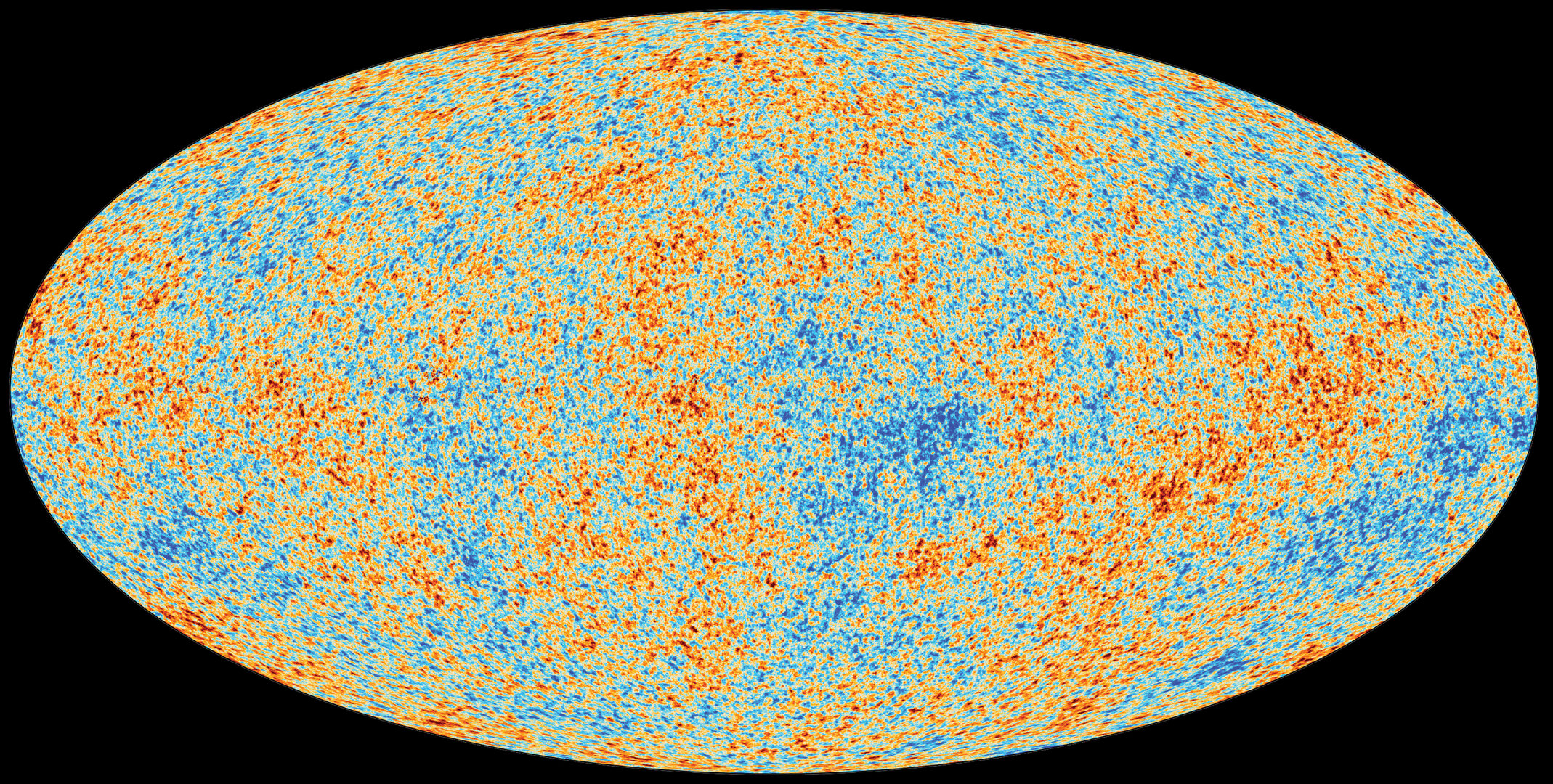
If we continue looking deeper into space, and therefore further back in time, we eventually encounter a faint radiation that fills the entire universe. Astronomers call this radiation the Cosmic Microwave Background. This signal appears in every direction we observe. No matter where we point our telescopes, we detect the same ancient glow surrounding us like a vast cosmic shell.
Space missions such as the Planck Satellite have mapped this radiation with extraordinary precision. The cosmic microwave background represents the oldest light we can observe in the universe.
The Surface of Last Scattering
The cosmic microwave background originates from a distant boundary known as the Surface of Last Scattering.
To understand this idea, we must briefly imagine the universe shortly after its birth. In its earliest stages, the cosmos was incredibly hot and dense. Matter existed as a plasma of free electrons and atomic nuclei, while photons (particles of light) constantly collided with them. It is also called the Radiation Dominated Era of the universe. Because of the continuous collisions of photons in this era, light could not travel freely through space. Instead, it scattered in random directions again and again. The universe behaved like an enormous fog where visibility remained extremely limited.
Then, about 380,000 years after the Big Bang, the universe cooled enough for electrons and protons to combine into neutral atoms. Once this happened, photons could finally travel through space without constant scattering. At that moment, the first freely moving light began its journey across the universe. The distant region where this occurred forms the surface of last scattering. Today, we detect those ancient photons as the cosmic microwave background.
Why Can't We See Beyond This Boundary?
The surface of last scattering marks the earliest moment in cosmic history that light can reveal. Anything that happened earlier remains hidden from direct observation. Before this moment, the universe was opaque. Photons constantly collided with charged particles, preventing them from traveling long distances. Just as thick fog blocks visibility on Earth, the early plasma blocked light from escaping. As a result, no optical telescope (no matter how powerful) can see past this boundary i.e. the radiation dominated era, which remains invisible to ordinary light.
Although we cannot observe this era directly using electromagnetic radiation, physicists reconstruct it using theoretical models. But keep in mind that no matter how confident physicists feel about those theoretical models, we cannot trust them unless they are verified by experimental observations.
Could We Ever See the Big Bang?
Although light cannot reveal the earliest universe, another type of particle might succeed where photons fail i.e. Neutrinos.
Neutrinos interact extremely weakly with matter. Unlike photons, they can travel through dense environments almost completely undisturbed. Because of this property, neutrinos produced in the early universe could potentially carry information from much earlier cosmic times.
In principle, if physicists could build a telescope capable of detecting these ancient neutrinos with sufficient precision, they might observe signals originating far closer to the Big Bang itself. On the other hand, building such a telescope which detects neutrinos is extremely difficult due to the very fact that neutrinos interact very very weakly with the matter.
The True Limit of Our Vision
When we ask how far we can practically see, the answer leads to a profound conclusion. Our vision does not stop at the horizon of Earth, nor even at the most distant galaxies. Instead, it extends all the way back to the surface of last scattering, where the first freely traveling light emerged in the early universe. Beyond that boundary lies a hidden chapter of cosmic history, one that ordinary light can never reveal. Yet the research continues. With new technologies and new ideas, humanity may eventually discover ways to explore even deeper into the universe’s earliest moments.
Or maybe, this is where you can chip in…